
The King James version of 2 Chronicles 16:9 reads like this:
For the eyes of the LORD run to and fro throughout the whole earth, to shew himself strong in the behalf of them whose heart is perfect toward him.
It’s a famous little verse, wrapped in the middle of a critique that the prophet Hanani issues to king Asa for relying on human strength instead of divine strength. Asa had a heart problem.
But what about that little word ‘perfect’? What’s going on there? Does God require ‘perfection’ in matters like this, or in general? Why would someone with a perfect heart need God to be strong for them? Aren’t they already perfect?
We could rightly point out that this is not some kind of unattainable Greek, mathematical, mechanical ‘perfection’ that is in view here. It is instead the complete, total and absolute orientation to God. Like when an Olympic athlete, skilled woodworker, tailor or electrician puts aside all distractions and focuses ‘entirely’ on the difficult task they are doing.
There are three components to the verse: The searching eyes of the Lord, the state of human hearts, and the resulting strength from God. Other translations swap out the word ‘perfect’ for ‘fully committed’, ‘blameless’, ‘fully devoted’, ‘loyal’ or ‘completely his’.
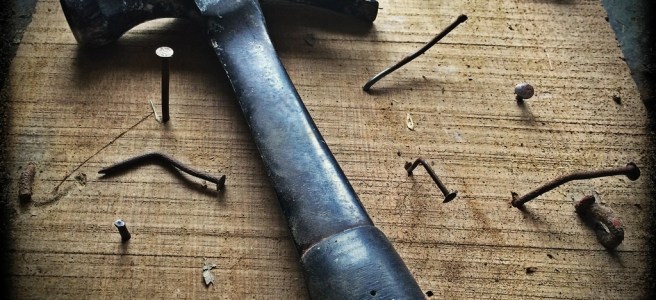
Some things in life are a spectrum like a dimmer switch, and other things are either/or, like a on/off switch. When a carpenter strikes a nail with a hammer, they either hit it or they miss (note: a miss also includes hitting it wrongly and bending the nail!). Careful, diligent focus on the nail head is required for the nail to be driven. With that kind of ‘perfect’ focus, the power of the hammer can be effective.
So then, this is less about some kind of ‘make sure you’re good so that God will love you’ kind of moralism or legalism. This is about the spiritual law that there is no transformation without our participation.
The 12 steps of Alcoholics Anonymous touch on this principle in step 6: “(we) Were entirely ready to have God remove from us all these defects of character.” For God to do the removing of the defects (discovered through the inventory of step 4 and disclosed to God, self and another in step 5), I must be ‘entirely ready’; and my actions must show this. God moves mountains, but I must bring a shovel.
God’s power to protect or transform is never forced upon us. It is released when we position ourselves in alignment to God and his loving purposes for his world. As Augustine said, without God, we ‘cannot’. But God ‘will not’ without us.

 Recovering the Kingdom