
the grace of presence

Sadly, I won’t be home for Christmas.

At least my original home…
I’ve lived almost as long in Aotearoa NZ as I did back home in the USA…
This has me thinking about place and presence.
And this, in turn, has me building a mental taxonomy of the different kinds of absence.

The choice between absence and presence becomes manifest at Christmas.

I Can’t Be There

One type of absence is simply about physics. As much as I might like to, science won’t let me be in Birkenhead, Auckland, New Zealand and Bolivar, Missouri, United States – at the same time – for Christmas.

This kind of absence is kind and regretful. I give my apologies and excuse myself.
It’s also very practical, as in, “Don’t include me in table-setting numbers.”

I Won’t Be There

There’s another type of absence that is not about physical possibility but perceived propriety. It’s about judgment. I am constrained not by physics, but by ethics.

After the 2024 re-election of Donald Trump, a phenomenon called “Boycotting Thanksgiving” happened, where people would protest both his re-election and family members who voted for him by absenting themselves from family Thanksgiving gatherings. Trump support trumps family relationships..

Ironically, boycotting your family at Thanksgiving for doing politics wrong reminds me of the Exclusive Brethren (Plymouth Brethren Christian Church) practice of ‘shunning’ your family for doing religion wrong.

This kind of in-your-face face-turning has many forms. ‘Snubbing’ or ‘blanking’ is famously pictured in The Sneetches by Dr. Seuss. The Star-belly sneetches, knowing themselves to be superior to the Plain-belly sneetches, “saunter straight past them without even talking.” It’s the same posture as the hilariously exaggerated arrogance of the Pharisee in Jesus’ parable where he thanks God he is not like the tax-collector (Luke 18:9-14).
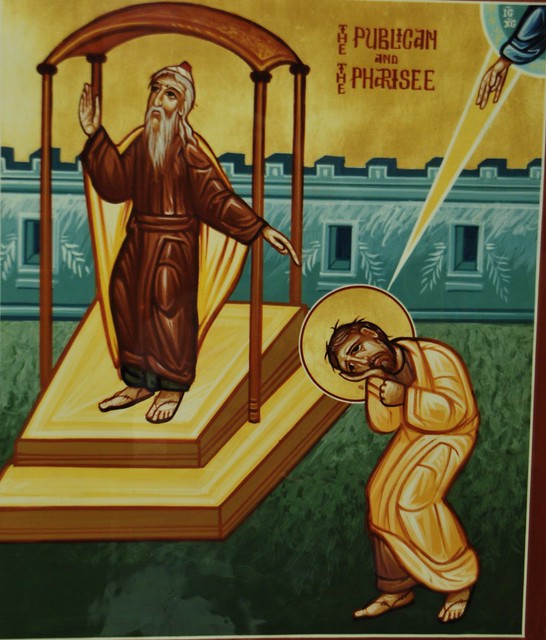
Publican & Pharisee Icon

This kind of absence is passive-aggressive and judgmental. I toss the hand-grenade over the wall and it explodes with the message that reads, “I won’t be around that person.” I protest the presence of ‘that person’ by excluding myself from the gathering or denying them the dignity of eye-contact.

You Can’t Be There

The third kind of absence is about safety. And that makes it really tricky…

Safety is really important – obviously. For example, on the one hand, we need to reform our approaches to crime and incarceration, but on the other hand, the fact still remains that at least in specific situations some humans need to be kept away from other humans. But safety is different from what is sometimes called safety-ism…

What concerns me is when this kind of extreme language is used of much more ordinary situations. When ‘safety’ language is used to describe situations that are not truly dangerous, but about difference of opinion and clashes of personalities. Even more concerning is when such ‘safety’ language is used to justify excluding people from spaces.

Human spaces like churches, volunteer organisations, workplaces and sports teams will always have challenges, because of the humans that comprise them. But being ‘difficult’ is not the same thing as being ‘toxic’ or ‘unsafe’. It’s one thing to need some time-out in a situation, or put a time-limit on a conversation. There are a thousand ways to stay present with ordinary difficult people rather than excluding or rejecting them.

This kind of enforced absence can feel authoritarian. In the name of virtuous protection, it points the finger and says “Yep exclusion may sound rough, but that’s exactly what you deserve.” It imagines itself as rescuing victims from persecutors.

I’ll See You There

By contrast, Advent and Christmas is about the God who is omni-present (present everywhere) becoming uniquely and locally present in the person of Jesus Christ. The Creator whose presence surges through the cosmos in a way that electricity can only dream of, who never ‘left’ the creation, majestically ‘arrives’ within and connects to the the creation, to the earth, to humanity, to the nation of Israel, to Mary the Theotokos (the God-bearer).
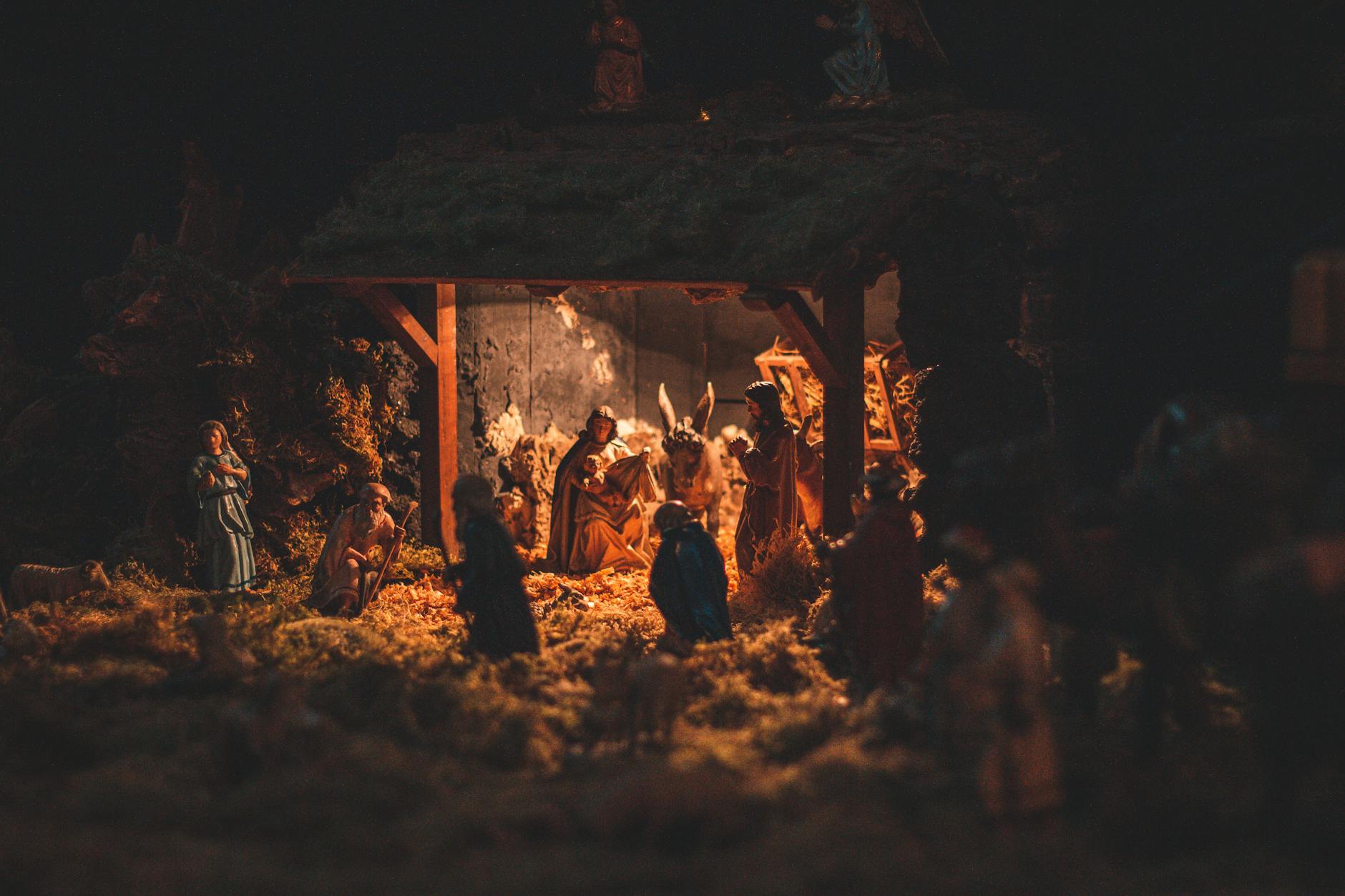
Photo by Burkay Canatar on Pexels.com

This is the God of Scripture who promises his unique presence (described by rabbinic tradition as Shekinah) in various ways, times and yes places. It’s the God who walks in the Garden, meets on Mountains like Sinai, dwells between the cherubim above the ark, and mysteriously descends to feed his people through Bread and Wine.

This is a vision of God whose cosmic presence is always a reality, but who will never coerce us to seek out, align with, and thus encounter and experience his local Presence. Christ is the Incarnation of a God who loves to welcome all who seek Him (including the ones we least likely expect to be looking for God). This is a Saviour who dines with the one who betrayed him to death. And who doesn’t flinch when religious leaders like priests, Pharisees and pastors exclude themselves from his presence.

It’s a God who is never ‘not there’.
It’s a God who says ‘I’ll see you there.’

What does this vision of God mean for us this Christmas?
It can mean as much as you dare to let it mean.

May it mean looking for the presence of God in those you are least likely to see it in.
May it mean going to that dinner, that function, that space where ‘they’ will be.
May it mean courageously seeking out that person you have cut off and extending an olive branch.
May it mean eye-contact or even a hand-shake with someone you don’t really like.

May it mean forgoing the judgment of absence…
And instead practicing the grace of presence.

the disturbing arrival of just mercy

For those of us in contexts with a wealth of technology and media (and a poverty of contentment and patience), many of us are feeling weary, tired and over it. This is an exhaustion that goes deeper than number of hours worked or slept. It is an underlying dissatisfaction with things… something… or maybe everything.

Further Fracturing…

Humans have had their usual military, political and personal dramas for aeons. But something is different. There is growing division and distrust and distance from one another. We are losing hope. Relationships seem more fragile. We have more and more reasons to avoid one another. More and more things are harder and harder to talk about. Discourse is toxic. Extremes widen. We seem strangely eager to uncover wrongs, and understandably terrified of being seen to be affiliated with anything wrong. We are determined to be right, or at least less wrong than ‘them’.

And underneath this, we are slowly waking up to the reality that our greatest boast in the modern world, science, is not the simple saviour we had hoped it was. We are beginning to admit that even an impressively comprehensive collection of accurate factoids cannot itself provide the epistemic basis for meaning, value, justice, human rights, compassion.

Worse still, it seems that our heroic efforts at making a more just world sooner or later take on the broken and fragile characteristics of our individual and collective psychologies. Our demonizing, defensiveness, vengeance, resentment, superiority (so often mixed with inferiority), fear and hopelessness end up pouring fuel on the fires of injustice. Seeking justice, we create more injustice.

As the Psalms frequently invite us to do: “Selah” (reflect on this for a moment)

The God of Just Mercy

The Christmas story, amidst all the consumptive noise, unintentionally exclusive gatherings, Santa hats and holiday ‘meh’, is about the arrival of the God of just mercy.

Luke’s historically-savvy Gospel understood well the reality of Roman oppression of 1st century Israel. Luke captures the song known as Mary’s Magnificat (see Luke 1:45-55), rich with feisty social justice themes of powerful people being cast down and rich being sent away empty, while the humble are lifted up and the poor are filled with good things. Despite what you may hear on streets or screens, the biblical Gospel was never only about individuals going to heaven after they die. God longs for his fair and just rule to be realised here on earth. Now.

To riff off of Isaiah 58, God is the breath in the lungs of the oppressed when they ‘lift up their voice’ (v.1) against oppressors – even (especially!?) religious oppressors (‘my people’ / ‘the descendants of Jacob’ v.1).

The Bible clearly and consistently shows God to despise oppression and injustice, but we should not mistake the Gospel for the kind of popular rage that wants to burn it all down. God doesn’t burn for the sake of burning. Like a farmer burning off a field, the fire is for fresh grass to grow.

The Magnificat ends with mercy.

Yes, the immediate focus is on mercy to the ancestors of Abraham, but those who know Scripture will recall that Abraham (Genesis 12:1-3) and his people had a vocation not simply to burn with judgmental finger-pointing at the nations forever, but to be a channel of blessing to them. The prophet Jeremiah knew that even in exile among their oppressors, the victim mentality that so often justifies violence would do them no good. Before Christ ever said “love your enemies and pray for those who persecute you”, he told the captives to “seek the peace of the city…” Even in Babylon, a city continually reminding Israel of their oppression, Jeremiah wants them to have a different stronger memory of his words that “in its peace you shall have peace.” (Jeremiah 29)

God is not revealed as a tyrant in the thunderclouds, who gets a real kick every time he gets a chance to topple, expose, shame or punish someone. Yes, God is angry at oppression to be sure. But God knew the familiar patterns of injustice long before we did. God knows that oppressors often justify their oppression with their own claimed (or maybe even real) experience of oppression. God knows the cycle. Nobody’s hands are really clean.

Justice – and Mercy – for Everyone?

God knows that justice has to be mixed with mercy and hope – for everyone.
Obviously the oppressed… but even oppressors.

The Oppressed are offered hope that oppression will not go unpunished in the end, and practical real-world assistance as the God of justice empowers down-to-earth help from their neighbours, allies and prophets.

As for Oppressors, yes they are summoned to repair the damage they’ve done as best they can, but they too are offered the hope of renewal and new life. For Israel who “oppresses all [their] workers” and more, they are challenged to change, for sure.

But… they are also told of the life they can have if they do.

And that is at least one ingredient that missing in our world. A justice that is merciful and vulnerable. A justice for all. Hope for all. A God whose compassionate justice – whose just mercy – is well described from the times of Exodus:

Punishment and Forgiveness.
Justice and Mercy.
Consequences and Restoration.
Held together in redemptive, transformative tension.

This God does not leave oppressors to oppress. The consequences of injustice are firm and full punishment. But nonetheless, even the “wickedness, rebellion and sin” of oppressors can be forgiven and overcome.

The author of the persistently profound hymn extolling the wonder of a Grace that “saved a wretch like me” is none other than an oppressor – the former slave-owner John Newton.

This is a merciful justice that may disrupt our popular rage or political resentment. But it just may be the one solution to injustice that actually works. If we would have the courage, and yes the mercy, to give it a try.

Have a merry and merciful (and just) Christmas.