
the grace of presence

Sadly, I won’t be home for Christmas.

At least my original home…
I’ve lived almost as long in Aotearoa NZ as I did back home in the USA…
This has me thinking about place and presence.
And this, in turn, has me building a mental taxonomy of the different kinds of absence.

The choice between absence and presence becomes manifest at Christmas.

I Can’t Be There

One type of absence is simply about physics. As much as I might like to, science won’t let me be in Birkenhead, Auckland, New Zealand and Bolivar, Missouri, United States – at the same time – for Christmas.

This kind of absence is kind and regretful. I give my apologies and excuse myself.
It’s also very practical, as in, “Don’t include me in table-setting numbers.”

I Won’t Be There

There’s another type of absence that is not about physical possibility but perceived propriety. It’s about judgment. I am constrained not by physics, but by ethics.

After the 2024 re-election of Donald Trump, a phenomenon called “Boycotting Thanksgiving” happened, where people would protest both his re-election and family members who voted for him by absenting themselves from family Thanksgiving gatherings. Trump support trumps family relationships..

Ironically, boycotting your family at Thanksgiving for doing politics wrong reminds me of the Exclusive Brethren (Plymouth Brethren Christian Church) practice of ‘shunning’ your family for doing religion wrong.

This kind of in-your-face face-turning has many forms. ‘Snubbing’ or ‘blanking’ is famously pictured in The Sneetches by Dr. Seuss. The Star-belly sneetches, knowing themselves to be superior to the Plain-belly sneetches, “saunter straight past them without even talking.” It’s the same posture as the hilariously exaggerated arrogance of the Pharisee in Jesus’ parable where he thanks God he is not like the tax-collector (Luke 18:9-14).
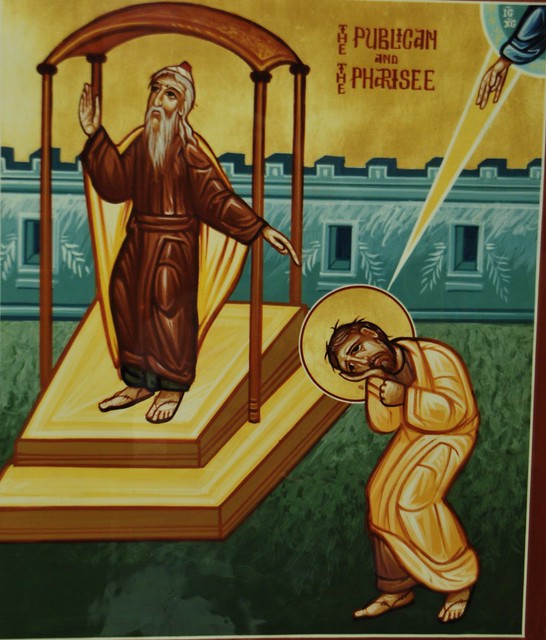
Publican & Pharisee Icon

This kind of absence is passive-aggressive and judgmental. I toss the hand-grenade over the wall and it explodes with the message that reads, “I won’t be around that person.” I protest the presence of ‘that person’ by excluding myself from the gathering or denying them the dignity of eye-contact.

You Can’t Be There

The third kind of absence is about safety. And that makes it really tricky…

Safety is really important – obviously. For example, on the one hand, we need to reform our approaches to crime and incarceration, but on the other hand, the fact still remains that at least in specific situations some humans need to be kept away from other humans. But safety is different from what is sometimes called safety-ism…

What concerns me is when this kind of extreme language is used of much more ordinary situations. When ‘safety’ language is used to describe situations that are not truly dangerous, but about difference of opinion and clashes of personalities. Even more concerning is when such ‘safety’ language is used to justify excluding people from spaces.

Human spaces like churches, volunteer organisations, workplaces and sports teams will always have challenges, because of the humans that comprise them. But being ‘difficult’ is not the same thing as being ‘toxic’ or ‘unsafe’. It’s one thing to need some time-out in a situation, or put a time-limit on a conversation. There are a thousand ways to stay present with ordinary difficult people rather than excluding or rejecting them.

This kind of enforced absence can feel authoritarian. In the name of virtuous protection, it points the finger and says “Yep exclusion may sound rough, but that’s exactly what you deserve.” It imagines itself as rescuing victims from persecutors.

I’ll See You There

By contrast, Advent and Christmas is about the God who is omni-present (present everywhere) becoming uniquely and locally present in the person of Jesus Christ. The Creator whose presence surges through the cosmos in a way that electricity can only dream of, who never ‘left’ the creation, majestically ‘arrives’ within and connects to the the creation, to the earth, to humanity, to the nation of Israel, to Mary the Theotokos (the God-bearer).
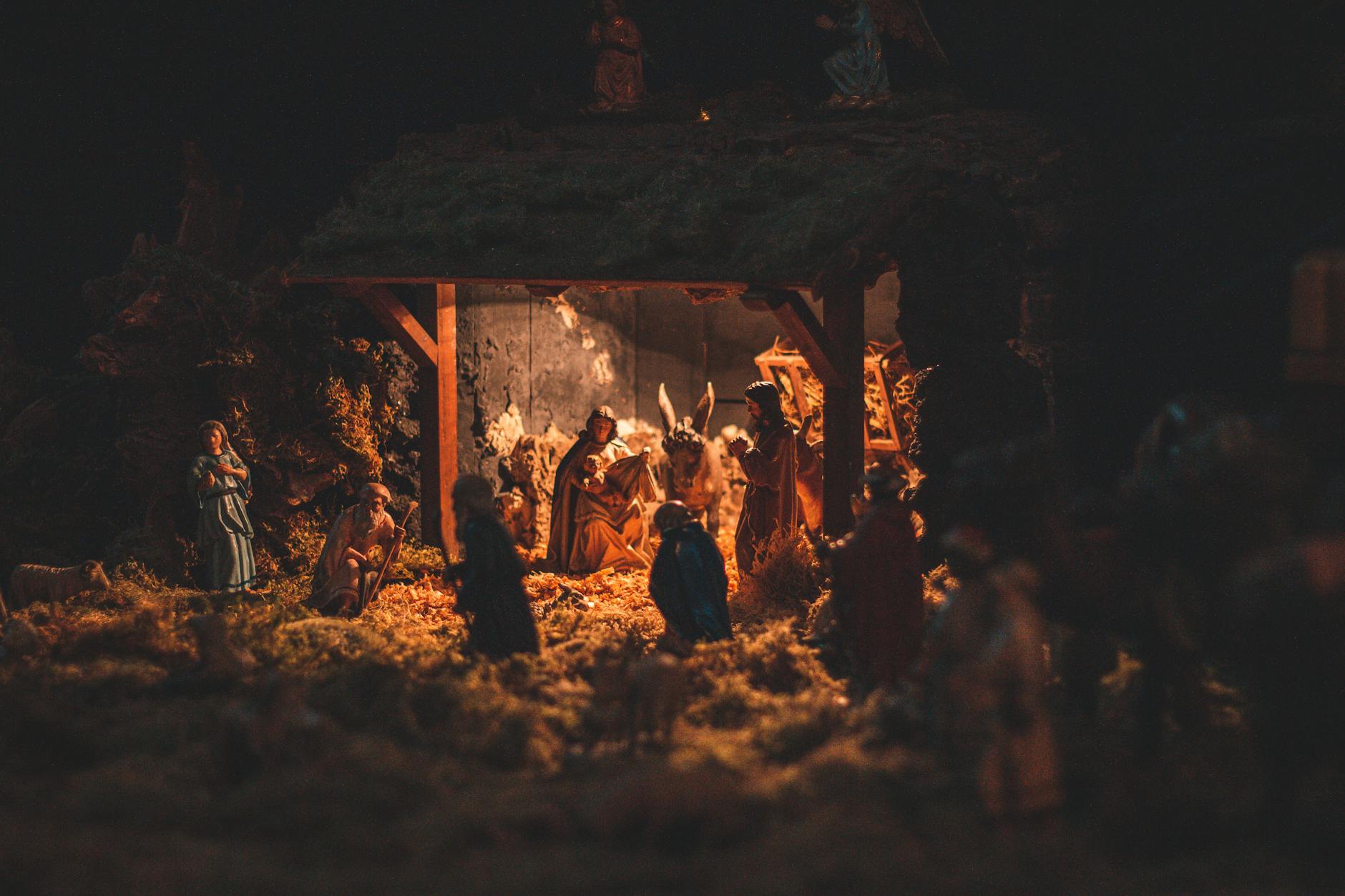
Photo by Burkay Canatar on Pexels.com

This is the God of Scripture who promises his unique presence (described by rabbinic tradition as Shekinah) in various ways, times and yes places. It’s the God who walks in the Garden, meets on Mountains like Sinai, dwells between the cherubim above the ark, and mysteriously descends to feed his people through Bread and Wine.

This is a vision of God whose cosmic presence is always a reality, but who will never coerce us to seek out, align with, and thus encounter and experience his local Presence. Christ is the Incarnation of a God who loves to welcome all who seek Him (including the ones we least likely expect to be looking for God). This is a Saviour who dines with the one who betrayed him to death. And who doesn’t flinch when religious leaders like priests, Pharisees and pastors exclude themselves from his presence.

It’s a God who is never ‘not there’.
It’s a God who says ‘I’ll see you there.’

What does this vision of God mean for us this Christmas?
It can mean as much as you dare to let it mean.

May it mean looking for the presence of God in those you are least likely to see it in.
May it mean going to that dinner, that function, that space where ‘they’ will be.
May it mean courageously seeking out that person you have cut off and extending an olive branch.
May it mean eye-contact or even a hand-shake with someone you don’t really like.

May it mean forgoing the judgment of absence…
And instead practicing the grace of presence.

sword & shield v. cross & towel

All humans carry a sword and a shield.

We strike out at and critique others with our verbal, philosophical, political, social or literal swords. We block and defend ourselves from criticism with our good intentions, mimising excuses, self-justifying reasoning. Our shields.

It’s not that we should never defend ourselves, and I don’t know if we should be surprised that people and nations frequently want to have at least some kind of readiness to respond to violence. It’s just that the sword and shield become a way of being. They shape us into people whose tendency is to critique others and defend ourselves.

This even happens within ourselves, psychologically. We divide ourselves into parts: parent / child, good / bad, the rebel / the law, or what have you… One part of us critiques the other part, and the other part defends itself. We don’t have to suffer from multiple-personality disorder to relate to the experience of feeling simultaneously innocent and righteous on the one hand and victimised and full of self pity on the other hand. It’s the sword and shield again. Just directed inward.

Christianity offers a way of life where we trust God to be our sword and shield.

We don’t need to take up the sword against others and sort them out. (Or ourselves.) God is just. (And merciful.) The biblical wisdom is that God almost always does this in his usual way – by delegation. Natural law, imperfect human governments, communal or relational systems. Injustice has its day, but eventually gets toppled. When we try to rush the process with our swords, we end up becoming what we hate.

We also don’t need to overly defend or protect ourselves from critique. God is our fortress, tower, shield, and defender. The great irony is that when I live in the freedom of not worrying what might happen to me (gossip, violence, theft, you name it), those things don’t have any power over me. I trust that God will deal with them as he will, and when he will. Ultimately, the biblical narrative promises a final justice that will heal all wounds and restore all things. I can choose to take comfort in that.

Christ – at Christmas and at all times – comes to us asking for an exchange.
He wants our swords and shields, and offers us a cross and a towel.

I am offered a cross. An instrument of death and violence to myself. I am not expected to do what Jesus alone could do – atone for the sins of the world. I am invited, expected or even commanded to follow his way. To ‘take up my cross and follow’ him. To live sacrificially is not the way of self-loathing – constantly criticizing, punishing and judging myself. As the cliche truth goes, it’s not “thinking less of myself, but thinking of myself less.”

And this leads to the towel. I am to become a servant. Not a show off servant. Not “Hey everyone, I’m just going to pick up this piece of rubbish… aren’t I a great person….” Not “Hey everyone, look how pissed off I am about social injustice… I probably hate oppressors more than anyone I know…” Not this. Real service. Service that can go unnoticed. Uncelebrated.

The world is full of divided politics, communities, families and selves. If we’re honest, we’ll be able to see how we participate in wleding the sword of criticism, and raising the shield of self-justification.

The world needs more cross bearers and towel servants.

That is precisely what Jesus taught and modeled. It is his plan to bring his kingdom where needs are provided for, sinners are forgiven, and humans live in grateful peace.

cultural, bi-cultural, multi-cultural, trans-cultural?

The current legislative discussions around Te Tiriri o Waitangi / The Treaty of Waitangi seem to be about culture.

For David Seymour, his concern (legitimate or not) is that one way of interpreting the Treaty would award “special rights” based on “ancestry”, which he feels violates his understanding of equal rights for all individuals. He thinks Te Tiriti sets up one government (‘kawanatanga‘) for all. One set of laws for all. Equal rights for all. This language of equality is deeply intuitive to many. The debate centres on the extent, nature and scope of that government. My own suspicion, which I hold very lightly, is that the hesitance of some Māori to sign Te Tiriti, lends weight to the view that ‘te Kawanatanga katoa o o ratou wenua’ indeed refers to total (‘katoa’) government over the land (‘whenua’). According to this understanding, Māori were clear what was being proposed, but as some of their chiefs (rangatira) had travelled widely and were wisely aware how colonisation had negatively affected other peoples, were concerned about whether or not this proposed ‘Kawana’ (a loan word for the English ‘Governor’) was going to truly protect their best interests. Sadly it turned out that land was unjustly sold and taken.

For some (or even many) Māori and their allies seeking to honour Te Tiriti, the concern is that the current system of government fails to give them the voice, influence and self-determination (‘tino rangatiratanga‘) which they (as they see it) are promised in article two of Te Tiriti. From this point of view, the structure of Parliament and system for governing the country are not ‘neutral’ but reflect British/European culture. Te Tiriti is seen as a safeguard against European cultural dominance, promising that colonisation, immigration and settling of Europeans will not overwhelm or erase Māori people, lands, and ways of being.

Since 1840, when Te Tiriti was signed, many people from other cultures (Asian, African, ‘American’) have also migrated, which adds a multi-cultural expression to the nation.

So, reviewing, we have:

a) an indigenous culture which is promised a very real degree of ‘tino rangatiratanga’ (self-determination or ‘chiefly rule’) over their own lands, and a settler culture which is (arguably) given the right to exercise ‘kawanatanga’ (government) over the ‘wenua’ (land)
b) a Treaty that is rightly seen as ‘bi-cultural’ between the Queen of England and the United Tribes of Nu Tirani (New Zealand).
c) a modern multi-cultural reality where Te Tiriti gives migrants the right to call Aotearoa / New Zealand home.

Is there a ‘transcultural‘ layer in the mix?

One of the major active parties involved in the drafting, translation, negotiation and signing of Te Tiriti – that is the Missionaries, notably Henry Williams – were motivated by their understanding of The Gospel (Te Rongopai). Whilst Māori, as of 1840, would understandably be skeptical about what this proposed incoming ‘Kawanatanga‘ would mean for their people, the previous two decades had seen an overwhelmingly positive response to the incoming message of ‘Rongopai’. As leading Māori historian Monty Soutar argued at an event I attended in 2019, it is the height of Eurocentric condescension to argue that Māori were tricked into welcoming this foreign religion. He is well versed in the history of intelligent weighing and welcoming of the Gospel among his people. Some estimates are that up to 90% of Māori were Christian around 1840.

I take it as obvious that these 19th century agents of mission were imperfect (sometimes extremely so). They inherited, carried and expressed an assumption of cultural superiority. This is famously seen in Samuel Marsden’s estimation that Australian aboriginals were not developed enough to have the Gospel shared with them. Despite this, Māori (and Australian aboriginals too) were intelligently and wisely able to see beyond the messengers to the message, which so many of them saw as good for their people. Thus comes into focus the ability of the Gospel to be (as missiologist David Bosch describes) ‘infinitely translatable’.

Gambian missiologist Lamin Sanneh points out that, despite the very real assumptions of cultural superiority at work, the very act of translation of the Scriptures into the many languages and cultures the missionaries went was itself inherently humanising and preserving. This is a message that does not destroy culture as it is planted into it. In the first century, when a male, female, Jew, Gentile, slave or free person became a Christian, this did not meant that their male-ness or female-ness was erased or downgraded. Rather who they were was enhanced and arguably transformed. English folk become more human, more Christ-like English folk. Māori likewise arguably judged that their people would be enriched and humanized by Te Rongopai. That vision of a humanising movement was at the heart of humanitarian and Christian groups like The Clapham Sect, which had such an influence on the wording of Te Tiriti; demanding that indigenous peoples be protected.

So then, there seems to be a kind of parallel when it comes to the present debate. I can imagine that some, perhaps David Seymour, will be imagining that ‘Parliament’ or ‘the Government’ is transcultural – neutral – objective; and that it is this neutral ‘democratic’ equality that is obviously needed here. My strong suspicion is that there needs to be a fresh awareness that The Westminster system of Parliament is indeed aligned to a particular British cultural system and not ‘neutral’. What should it – what could it – look like instead to have a (bi-cultural / multi-cultural / trans-cultural) Kawanatanga where two things could be simultaneously a reality:

  1. all could share ‘democratically’ in the same universal and general rights under one Law,
  2. but in a way that properly and thoroughly preserves and protects the particular rights due to any and all peoples (starting with and never excluding iwi & hapu (tribe & sub-tribe) Māori who are explicitly protected in Article 2 of Te Tiriti)

I have no idea what this would look like, but it seems to beautifully smell like both Te Rongopai and Te Tiriti.