
the grace of presence

Sadly, I won’t be home for Christmas.

At least my original home…
I’ve lived almost as long in Aotearoa NZ as I did back home in the USA…
This has me thinking about place and presence.
And this, in turn, has me building a mental taxonomy of the different kinds of absence.

The choice between absence and presence becomes manifest at Christmas.

I Can’t Be There

One type of absence is simply about physics. As much as I might like to, science won’t let me be in Birkenhead, Auckland, New Zealand and Bolivar, Missouri, United States – at the same time – for Christmas.

This kind of absence is kind and regretful. I give my apologies and excuse myself.
It’s also very practical, as in, “Don’t include me in table-setting numbers.”

I Won’t Be There

There’s another type of absence that is not about physical possibility but perceived propriety. It’s about judgment. I am constrained not by physics, but by ethics.

After the 2024 re-election of Donald Trump, a phenomenon called “Boycotting Thanksgiving” happened, where people would protest both his re-election and family members who voted for him by absenting themselves from family Thanksgiving gatherings. Trump support trumps family relationships..

Ironically, boycotting your family at Thanksgiving for doing politics wrong reminds me of the Exclusive Brethren (Plymouth Brethren Christian Church) practice of ‘shunning’ your family for doing religion wrong.

This kind of in-your-face face-turning has many forms. ‘Snubbing’ or ‘blanking’ is famously pictured in The Sneetches by Dr. Seuss. The Star-belly sneetches, knowing themselves to be superior to the Plain-belly sneetches, “saunter straight past them without even talking.” It’s the same posture as the hilariously exaggerated arrogance of the Pharisee in Jesus’ parable where he thanks God he is not like the tax-collector (Luke 18:9-14).
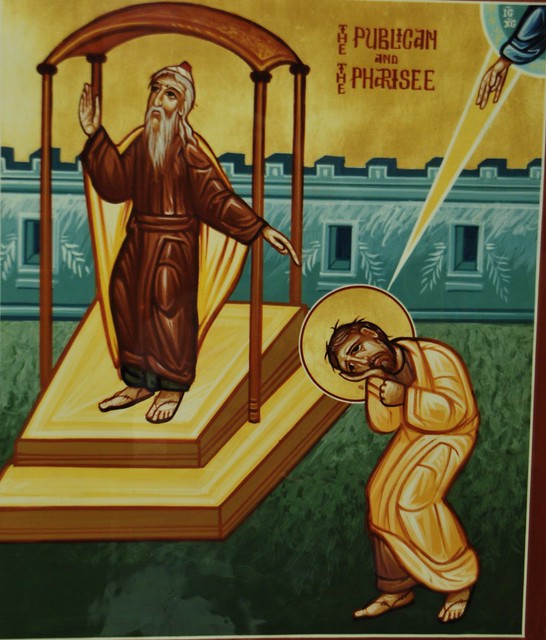
Publican & Pharisee Icon

This kind of absence is passive-aggressive and judgmental. I toss the hand-grenade over the wall and it explodes with the message that reads, “I won’t be around that person.” I protest the presence of ‘that person’ by excluding myself from the gathering or denying them the dignity of eye-contact.

You Can’t Be There

The third kind of absence is about safety. And that makes it really tricky…

Safety is really important – obviously. For example, on the one hand, we need to reform our approaches to crime and incarceration, but on the other hand, the fact still remains that at least in specific situations some humans need to be kept away from other humans. But safety is different from what is sometimes called safety-ism…

What concerns me is when this kind of extreme language is used of much more ordinary situations. When ‘safety’ language is used to describe situations that are not truly dangerous, but about difference of opinion and clashes of personalities. Even more concerning is when such ‘safety’ language is used to justify excluding people from spaces.

Human spaces like churches, volunteer organisations, workplaces and sports teams will always have challenges, because of the humans that comprise them. But being ‘difficult’ is not the same thing as being ‘toxic’ or ‘unsafe’. It’s one thing to need some time-out in a situation, or put a time-limit on a conversation. There are a thousand ways to stay present with ordinary difficult people rather than excluding or rejecting them.

This kind of enforced absence can feel authoritarian. In the name of virtuous protection, it points the finger and says “Yep exclusion may sound rough, but that’s exactly what you deserve.” It imagines itself as rescuing victims from persecutors.

I’ll See You There

By contrast, Advent and Christmas is about the God who is omni-present (present everywhere) becoming uniquely and locally present in the person of Jesus Christ. The Creator whose presence surges through the cosmos in a way that electricity can only dream of, who never ‘left’ the creation, majestically ‘arrives’ within and connects to the the creation, to the earth, to humanity, to the nation of Israel, to Mary the Theotokos (the God-bearer).
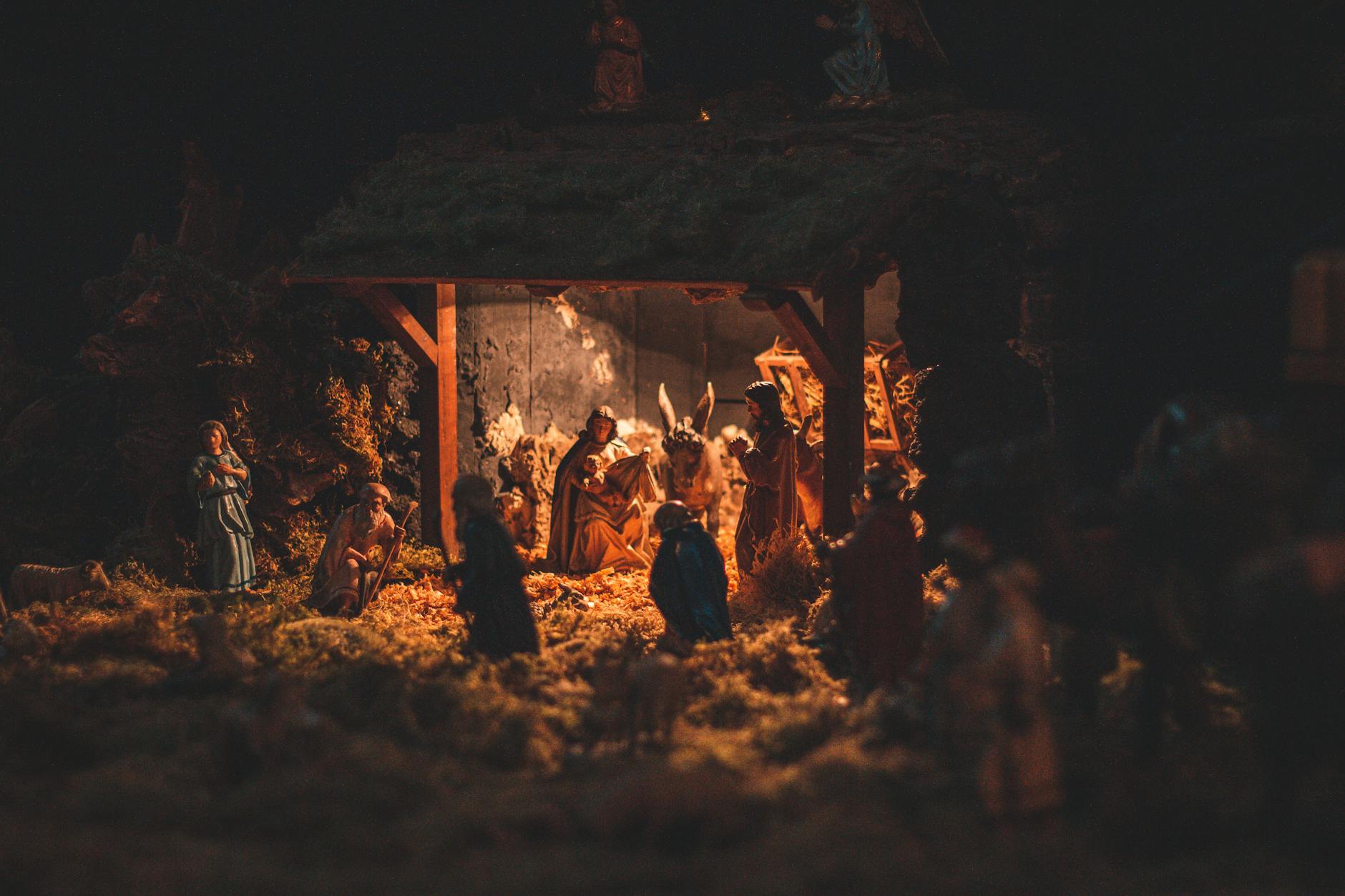
Photo by Burkay Canatar on Pexels.com

This is the God of Scripture who promises his unique presence (described by rabbinic tradition as Shekinah) in various ways, times and yes places. It’s the God who walks in the Garden, meets on Mountains like Sinai, dwells between the cherubim above the ark, and mysteriously descends to feed his people through Bread and Wine.

This is a vision of God whose cosmic presence is always a reality, but who will never coerce us to seek out, align with, and thus encounter and experience his local Presence. Christ is the Incarnation of a God who loves to welcome all who seek Him (including the ones we least likely expect to be looking for God). This is a Saviour who dines with the one who betrayed him to death. And who doesn’t flinch when religious leaders like priests, Pharisees and pastors exclude themselves from his presence.

It’s a God who is never ‘not there’.
It’s a God who says ‘I’ll see you there.’

What does this vision of God mean for us this Christmas?
It can mean as much as you dare to let it mean.

May it mean looking for the presence of God in those you are least likely to see it in.
May it mean going to that dinner, that function, that space where ‘they’ will be.
May it mean courageously seeking out that person you have cut off and extending an olive branch.
May it mean eye-contact or even a hand-shake with someone you don’t really like.

May it mean forgoing the judgment of absence…
And instead practicing the grace of presence.

Silkworth, Buchman & Bill

Alcoholics Anonymous resulted from a combination of two historical trajectories.


One of these had to do with certain people at a certain time wrestling with the puzzle of a particular type of alcoholic. The best doctors, notably William Silkworth and Carl Jung had found their methods utterly ineffective for a certain type of drinker. Silkworth and Jung effectively said to Bill Wilson and Rowland Hazard – we’ve tried everything we know, and we can’t help you. Bill and Rowland were the type of alcoholic who drank even when they didn’t want to, even when they knew a great deal of accurate knowledge about their drinking experience.

To varying degrees, and with varying experiences, they would be overcome by what Silkworth called a physical ‘allergy’ to alcohol, which triggered a phenomenon of craving. One drink could usually trigger this. They also had a mental obsession, or a kind of blank spot, which meant all previous experience of suffering and humiliation and damage went out the window. The alcoholic ‘thinking’ that precedes, justifies, rationalizes or just throws in the towel just before the first drink.

Though such drinkers were often perfectly normal in other respects, being good men, successful businessmen, skilled physicians, etc., will power seemed to be non-operative with regard to alcohol. Their only hope, according to Silkworth and Jung, was what some called ‘vital spiritual experiences’, which had seen some of these types recover. But such miracles were rare and little understood. Alcoholics like Bill and Rowland were sent off looking for such a solution…


The second historical trajectory had to do with other people at another time seeking to get back to the basics of religion – in this case, Christianity. This trajectory in a sense goes all the way back to the dawn of humanity and all religious ideas, but in more practical terms it starts with the experience of Frank Buchman.

Buchman was a Lutheran minister who had started up a hospice for young men, and had grown so upset at the board over financial disagreements that he resigned. At the 1908 Keswick convention in England, a message preached by Jesse Penn-Lewis brought him face to face with his self-focused, self-justifying anger. He came to see that they had probably wronged him, but the main point for him was that he had gotten “so mixed in the wrong that I was the seventh wrong man.”

This foundational pivot, a perfect example of taking the log out of your own eye (Matthew 7:5), set Frank on a trajectory of founding the First Century Christian Fellowship, a movement seeing to embody a return to the original teachings of Christ, simple and practical. This fellowship, later known as the Oxford Group, had a particular affection for the Sermon on the Mount, the Lord’s Prayer, and the epistle of James. They were convinced that faith without works was useless, and that one must clear their blockages from God, be of service to others practically, and seek constant daily direction from God through prayer and meditation.

This movement, seeking to build Christianity down to it’s most vital elements, grew in effectiveness and size. Though they had no formal articulation of their process, through their four absolutes (Honesty, Unselfishness, Purity & Love), they saw the lives of many people with various struggles turned around, including many alcoholics. One in particular went by the name of Ebby Thatcher.


These two trajectories were made for one another, and would merge in the person of Bill Wilson.

Bill Wilson was one of those rare types of drinkers for whom there seemed no solution, save the rare spiritual kind. He was a friend of Ebby Thatcher, who had been dramatically sobered up through the Oxford Group. The story of Ebby sharing his experience with Bill is featured in chapter 1 of the Big Book of Alcoholics Anonymous, called ‘Bill’s Story’. At the time of the writing of the book, according to one of the foundational stories called ‘He Sold Himself Short’, the Oxford group had a sub-group of Alcoholics who seem to have tailored the Oxford process into a sequence of 6 steps, as used by Dr. Bob (the co-founder of A.A.):

1, Complete deflation.
2. Dependence and guidance from a Higher Power.
3. Moral inventory.
4. Confession.
5. Restitution.
6. Continued work with other alcoholics.

Bill and nearly a hundred other alcoholics adopted the Oxford process and formulated the 12 steps of AA as they are known now.

1. We admitted we were powerless over alcohol — that our lives had become unmanageable.
2. Came to believe that a Power greater than ourselves could restore us to sanity.
3. Made a decision to turn our will and our lives over to the care of God as we understood Him.
4. Made a searching and fearless moral inventory of ourselves.
5. Admitted to God, to ourselves, and to another human being the exact nature of our wrongs.
6. Were entirely ready to have God remove all these defects of character.
7. Humbly asked Him to remove our shortcomings.
8. Made a list of all persons we had harmed, and became willing to make amends to them all.
9. Made direct amends to such people wherever possible, except when to do so would injure them or others.
10. Continued to take personal inventory and when we were wrong promptly admitted it.
11. Sought through prayer and meditation to improve our conscious contact with God as we understood Him, praying only for knowledge of His will for us and the power to carry that out.
12. Having had a spiritual awakening as the result of these Steps, we tried to carry this message to alcoholics, and to practice these principles in all our affairs.

When you look at the steps, especially as they are explained in the AA Big Book, you can see that the first two steps encapsulate the wisdom of Dr Silkworth concerning the unique powerlessness and insanity of the alcoholic concerning alcohol. The rest of the programme seems clearly dependent on the process of the Oxford Group.

So there you have it.

Silkworth & Jung found that the alcoholic problem needed a spiritual solution
Frank/OG spread a spiritual solution that relieved all kinds of problems.
Bill and the early AA’s said yes – thank you.